Wednesday, July 29, 2009

Life's Interuptions: An Unexpected Day

A Jackson Pollock painting.

Today felt like a 'Jackson Pollock' painting. Lines coming from every direction, unexpected, seemingly chaotic, that eventually come together to create a larger picture. C. S. Lewis has said that interruptions don't stop us from living, but rather, the interruptions are our life, given to us from God. That the interruptions ARE life - rather than simply events that interfere with life. The unexpected, rather than the planned, describe the majority of our days on this earth. Thankfully, unlike a Jackson Pollock painting, God promises that the 'chaos' has purpose and meaning (Rom 8:28, Jeremiah 29:11).

Today felt like a Jackson Pollock painting, with 'interruptions' coming at every turn. I had four things planned for my day, and by lunchtime I had to throw the plan out the window.


Today's 'Plan'What Actually Happened
Work on Ch. 5
Take a taxi to Forest Side
Visit with Catherine
Bike to and from gym
Go to Gym
Stop by Library
Read Lonsdale Article
Sort out rental van for friends visiting next week
Visit with Seth & Julie
Seth & Julie give me a lift to Forest Side (a huge blessing!)
Visit with Catherine
Bus drops me off downtown, so:
Fill up empty bus card
Get haircut
Stop by pharmacy
Pick up gift for a friend
Go home, then bike back to gym
Stop by library
Get feedback from Megan on ch. 3 & 4 (Much appreciated!!)
Get feedback from supervisor, Prof. Jeffery, on Ch. 4 (also much appreciated!)
Go to gym (only to find out membership has expired)
Offend a friend after misunderstanding what he had offered to do
Bike home
Eat dinner
Write blog
Still to happen:
Take shower
Hopefully some work on ch. 5

Needless to say, this hasn't been the day I expected. It was full of changes and surprises. I definitely thought my gym membership was good through the end of September and didn't see the offer from this friend coming - making my offense even worse. Didn't plan on spending the afternoon downtown waiting on a haircut or running errands, nor meeting with Megan or Prof. Jeffery.

This morning I posted on my Facebook status that there are days where I just have to trust God to work out the details because life feels like it's falling apart. That was today. I have no idea how I'm going to get this chapter written before Sunday morning, nor how I'm going to fit in all the other pieces that need to be sorted before friends come - train tickets, car rental, house ready...but I'm trusting that what needs to happen will happen. I'll work to remain faithful to the tasks God guides me to do or places in my path, and trust Him. Trust that God, whom Lewis says brings these interruptions, knows what He's doing. (At almost 26 years old, I've learned that He does - but man, sometimes I wish I could see the whole picture! :-)

It's been 'one of those days'. It's also been a day that I realize I need to learn to roll with 'one of those days' better, to flex with the changes and roll with the punches. To really trust God in the midst of it and go through it in joy and gratitude. I'm working on it and I'm sure there'll be more chances too. So, here's to future chances to grow and be stretched.

Wednesday, July 22, 2009

When I Don't Rest

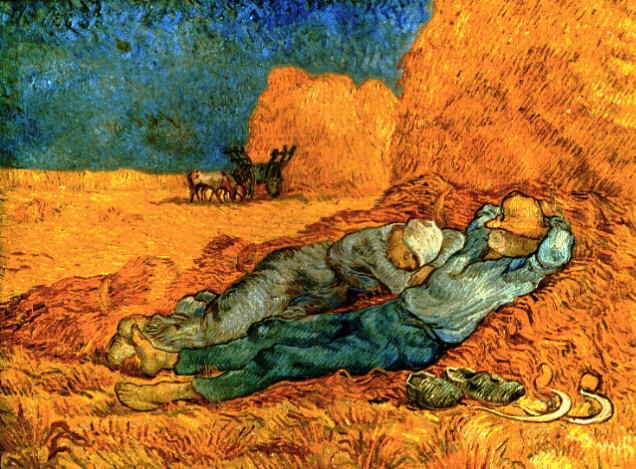
Van Gogh, 'Noon: Rest from Work'

I worked straight through this last weekend. It's not something I usually do. With two weeks till friends visit and behind on deadlines (self-imposed deadlines, I should add), I felt the need to keep working through the weekend. Chapters 4 and 5 were due Monday and I was way behind going into the weekend. In the end, neither were completed by Monday and I just finished up chapter 4 yesterday.

Working through the weekend, and missing the deadlines, has reminded me of something I had forgotten. Simply put, it's this: every part of me needs the break of a full-day away from work. There's a lot of reasons for this:

(1) A seven day week has turned into 10 days, and my body's wondering when the weekend is going to come. After a 10 day work week, my body is exhausted.

(2) Not taking a break has meant that the breaks during my days don't feel restful, because they're never enough to make up for what I skipped. Whether I take two hours for a movie with friends, go work out at the gym, or take a nap, at the end of each of the activities my body, mind, and spirit beg for more.

(3) As a result, I'm constantly looking for 'more' and my discipline and focus wains. This attempt to find that break comes out in all sorts of ways. Ironically, I blog a lot more when I haven't had breaks - it's a chance to get away from the paper or book I've been absorbed in. I sleep in later than I normally would; I spend more time on Facebook; I watch more T.V. These, and a host of other things, are all attempts at getting the break my body needs - but they're never enough.

(4) What had started as a 'work weekend' to get more done, has left me feeling tired, antsy for a chance to stop thinking about the project, a chance to let my imagination roam, to stop being productive for more than 30 minutes at a time, to rest.

It's a need for rest, not a break or a nap or a distraction. All of those are short and focus on the fact that there's something to get back to. They, inherently, infer that there's something we're stepping away from. Rest brings with it a sense of stopping, of ceasing from activity. It's what I realized I need.

Perhaps I'm the only one like that. I have friends who seem to always be working or thinking about working. I don't know if they ever take a full-day off and rest. Maybe they've been going 24/7 for so long that their minds and bodies have gotten used to it.

I've come to realize this week that I need that rest. I need to take a day in my week where little has to be done. Where my mind, body, or spirit can wander: through a novel, the outdoors, a devotional book, or a Psalm of David. It's that chance to give my whole being a break, not just who I am phsyically, emotionally, or spiritually, but every bit of me.

There's a word for it. It was something I've been told ever since I was a young boy. Truth be told, it's something that's been said for thousands of years. It's been abused through the years, like so many words and ideas that were supposed to be good for us - love, fear, submission, humility - that have been twisted, misunderstood, or abused.

It's a simple word, from an old language: sabbath, or, in the Hebrew, shabat. That day which God put into his ideal for the world, before sin ever entered it. The call to rest, having finished all the week's work. I forgot this week how much I need that rest. I forgot that the 'sabbath' was made for me - not as another day to have a list of things to accomplish - but as a rest from that productivity. My body, my soul, and my mind - all that I am, entirely created by God - needs it.

I think this weekend, I'll be taking a break. Scratch that. I'll rest and take a sabbath.

Tuesday, July 21, 2009

Learning a New Language. English.

A better title might have been, 'Relearning a Language I Thought I Knew'. I'm in the midst of my dissertation writing. As I complete each chapter, I send it to my supervisor for feedback. Today, we sat down to look over the first three chapters I had sent him. Among other things, I learned that I don't know the English language...well, at least not British English.

I was amazed at how many things are different. For those of you contemplating academic work on this side of the globe, here's some things I've learned:

Quotation Marks: In the U.S., the double quotation mark, ", is what we use to open and close quotations. If there happens to be a quotation within a quotation, we then use single, ', quotation marks to designate this interior quote. Well, turn everything on its head to fit in over here. The single quotation mark is used first, with the double quotation mark used for quotations within the original quotation.

Example (US): Koinange wanted to "give his life to assuage 'the educational hunger of three millions [sic] natives of Kenya'."

Example (UK): Koinange wanted to 'give his life to assuage "the educational hunger of three millions [sic] natives of Kenya"'.

You'll notice that quotation marks aren't the only thing that's different, but also where you put them. In the US, the punctuation almost always go inside the quotation mark.

Example: Berman writes, "Administrators in Kenya came to believe that there was no necessary linkage between African socio-economic problems and political action."

However, once again, flip it around here. With the rare exception that a complete, standalone sentence is used within the quotation, the punctuation always goes on the outside.

Example: Berman writes, 'Administrators in Kenya came to believe that there was no necessary linkage between African socio-economic problems and political action'.

Commas: Commas are also used differently here. For example, in the US, commas separate items in a list:

Example: Billy played soccer, basketball, and baseball.

Over here, there is no comma used in the last pairing of items.

Example: Billy played football, basketball and baseball.

The way we do it in the US is also known as the 'Oxford comma'. It seems as though they are one of the few places in the UK to place a comma in the last pair of items.

Spelling: Perhaps not surprising, words are spelled differently here than they are in the US. Here's some examples:

Where we would use 'ize' in the US, they would use 'ise' here.

Example (US): recognize

Example (UK): recognise

Where we would use an 'ense', they often use 'ence'.

Example (US): defense

Example (UK): defence

They like to add extra letters. For example, where we would use 'o', they'll use 'ou' and where we use one 'l', they'll use 'll'.

Example (US): color and traveled

Example (UK): colour and travelled

Where we would use 'er', they use 're'.

Example (US): center

Example (UK): centre

Introducing Persons and Quotations: In JBU's history and bible department, we were always taught to establish the credibility of someone we're citing. For example:

Jack Gallagher, the revered Cambridge scholar, gave a series of lectures on the British empire at Oxford University.

Here they expect that when you cite someone in your paper, they're an expert. As a result, you leave out the accolades.

Example: Jack Gallagher gave a series of lectures on the British empire at Oxford University.

[Side note: At this point in my paper, my supervisor, who trained under Jack Gallagher, made the comment, 'If they don't know who Jack Gallagher is, they have no business reading your paper.' :-)]

As well, if you're using a quote from a scholar, no need to say who you're using it from, your footnote does the work. So, for example, in my writing at JBU, I would have written:

Drake writes that Koinange "was on a political mission representing [the] KAU."

Here, however, it's better to just write:

Koinange 'was on a political mission representing [the] KAU'.

The footnote then tells the reader who it is that said it.

In Conclusion...
There are certainly lots of others intricacies that I've learned as I've stumbled along this year, these are just a few of them. We may both be speaking and writing in a language that goes by the same name, English, but there are times where I feel like I'm having to learn it all over again.

This doesn't even get into the way they grade over here (a mark of a 70 is an excellent mark and two professors grade your 'anonymous' paper), the use of Dr. vs. Prof., and the expectations for student-professor interaction. It's been a whole new ballgame! :-)

Thoughts on 'Harry Potter & the Half-Blood Prince'

I thought I'd jot down a few thoughts before moving on to dissertation editing. So, in no particular order, here are the thoughts from seeing the new Potter film with friends tonight:

*Don't start with this one - if you've never read the books, or haven't watched the other movies, at the very least, don't begin watching Harry Potter with this film. You'll be completely lost.

*The weight matches - part of the Harry Potter series is the maturing of the characters, there movement from childhood to adolesence to adulthood. As with reality, with age comes dealing with life's heavier things: death, war, disease, etc. It's in the latter years of high school that we start having to wrestle with the pain of loss. The books follow this, as the years in school (each Harry Potter book is one year in school) go by, the characters begin dealing with heavier and heavier things. This movie matches that well. While they balance it incredibly well with humor and laughs, there is a darkness that sets over the story as the showdown between good and evil comes ever closer.

*Contrasts and foils - I don't remember the book doing as good a job of this, but perhaps it did. There was a wonderful and vividly clear contrast throughout the movie tonight between the opposing sides. (1) Harry Potter is the 'chosen one,' but it doesn't become his all consuming identity or prideful. The foil to that is Draco Malfoy, Voldemort's 'chosen one' who lives in fear, takes it as his identity and pride - an identity that distances himself from everyone else in the school. (2) Harry's promise to follow Dumbledore's instructions is trusted, no need for anything more than Harry's word. For Snape and Narcissa though, especially for Bellatrix, there is no trust and so the unbreakable oath has to be made. (3) This theme of trust and mistrust contrasts the opposing sides of good and bad throughout the story. That for the 'good' guys, their is trust, faith, and loyalty in and towards one another. For the 'bad' guys, there's mistrust, traitors, and a lack of faith.

All in all, it was a really fun film and a great way to spend a couple of hours. Plenty of laughs, plenty to think about, and plenty to enjoy from the detail in the scenes to the CGI. As always, plenty to relate to: from Ron feeling like king of the world after doing really well in a sporting match to teenage infatuation to broken hearts to faithful friends to life's deepest regrets and to choices that redefine who the character is. A lot of fun! Looking forward to the next two!

Random Fact: Professor Severus Snape, played by Alan Rickman, is 63 years old and Maggie Smith, who plays Professor Minerva McGonagal is 75. Amazing to see these two actors still in these movies!

Monday, July 20, 2009

Why I Enjoy Harry Potter


I just finished an email to a friend who had asked why so many Christians my age (and younger) enjoy the Harry Potter books and films. The Harry Potter stories have, ever since they came out, been something that the Christian church has divided over. Point in fact, my parents don't like me bringing the books home or watching the movies, because of the part magic plays in the stories. I know my parents are not the only ones that have reservations and questions about the Harry Potter films.

I'm going tonight to see the new one, Harry Potter and the Half-Blood Prince, which has gotten great reviews from both secular and Christian movie reviewers. I thought, in light of that, I would post the email I just sent to this friend, in case anyone else might have the same question: Why would I spend time watching the movies and reading the books?

Note: Two things to be aware of: (1) this was originally an email, so it reads like an email and (2) the question was why Christian's enjoy the books, so my comments look at how the Harry Potter books reconcile with a Biblical worldview - not that they 'are Christian books' - but rather, how does the message, themes, story agree with and/or conflict with the message of Scripture. Please, if you're not a Christian, don't take this as a, "He's making them Christian books when they're just stories." :-)

Worth reading: World Magazine's Review and New Testament Pauline Scholar Ben Witherington III's review.
--------
[SPOILER ALERT: This was written to an audience that won't likely ever read the books, so it talks about the storyline of all of them - right up to the last book.]


On the most basic level, we enjoy them for the same reason anyone enjoys them - Christian or non-Christian. They're well written. They're fun stories that weave the reality of life, friendships, and tragedies into the life of the characters. They're fantastic, in that they carry the imagination like few books do these days. It's the same reasons that Tolkien's 'Lord of the Rings' and Lewis 'Chronicles of Narnia' still captivate the imagination and mind of both adults and children. They are stories of good fighting evil, of loyalty in friendship, of growing up, of making mistakes and learning from them.

Which, is also why, as a Christian, I really enjoy them. The very foundations of the Harry Potter stories are things that reflect a Biblical worldview. In a post-modern world, where nothing is right and we hate to speak of Sadam Hussein as evil or terrorists as evil, the Harry Potter stories declare, strongly and boldly, that the Potter world is a world of good & evil. There's no vagueness in it. And it is clear that the good side has won before and will win in the end, but only if good people choose to do something about it. Very much like Paul, who calls us to fight the good fight, to push boldly forward in this battle against the dark powers of this world.

Even more so, the stories are founded on the premise that the greatest power, greater than any magic, strength, or ability, is the power of sacrificial love. I'm assuming you likely won't read the books anytime soon, so I won't be giving away anything. But the premise of the book is that Harry Potter's mother died, sacrificing herself, to protect him. That love then, throughout Harry's life as an orphan, is what protects him - it 'seals' him. And it's that sacrifice and that love that Voldemort, the bad guy, spends the entire series battling against - to no avail. The last book (which the movies haven't come out yet), ends in Harry sacrificing his life for his friends, for his school, for his family. And, once again, it is what breaks the powers of Voldemort and evil. It's the one thing that Voldemort can't get his head around - because he can't imagine a world in which his life and his ambitions aren't the most important - and it ruins him. And yet, the answer of the Harry Potter series is that the greatest power, the greatest act, the greatest thing we can ever do is lay down our lives for others - even to the point of death (it echoes so strongly Christ's words to his disciples, 'greater love has no man than this, that he lay down his life for his friends).

And that's why I, and I think why many of my friends, really enjoy the books. They're fun, they're exciting - but above all, the values they uphold and that they show to be worthwhile are values of friendship, loyalty, sacrifice, and love. Often Harry Potter disobeys someone or fails to trust others, but it almost always ends up with him paying the consequences - someone else is hurt or put in danger.

Now, as for the place of magic in the stories. The reality is, and any Christian I know who's read the books seems to agree, that the magic is the stage for the story, it's not the story. There's sure to be better analogies, but it's like kids playing cops & robbers. We let them shoot each other, 'rob' things, etc. - because we know it's them using their imagination to have fun, to wrestle with the ideas - as small as they are - that there are good guys and bad guys in the world. But, they know that growing up being a robber isn't an okay thing and that shooting people or stealing things isn't okay. It's similar in these stories. The magic is part of the story telling, but a small part. The themes that come behind the magic are themes of faith - in ourselves and others - of serving others through our abilities (the 'magic'), and of growing up and developing confidence in who we are. At the same time, in the books, there's a very clear delineation between what's appropriate and what's not - in other words, what's okay magic (magic that serves and protects others) vs. evil magic (that harms, injures, or kills others).

J.K. Rowling, an Anglican Christian, has created a world - using the same literary methods of Tolkien and Lewis - where there is good and evil. Where there are choices we make and we pay the consequences for them. And, ultimately, that the greatest choice that has ever been made for us - or we can make for others - is to lay down one's life for another.

Monday, July 6, 2009

This 'Emerald Isle' & that 'New World'


Top: My cousin Tyler and I hanging out on the beach at Sullivan's Island.
Bottom: The Mourne Mountains overlooking Dundrum Bay.


What is it about anticipation that so preoccupies my mind? Throughout this year, I've had short spots of homesickness, where I've missed something particular in the US for an afternoon or a day. Now that I know I'm going back to the US and not staying in the UK for another 3 years, I find myself thinking about the States frequently.

The smell of the salt air and the beach as my family and I drive over the bridge from Charleston, South Carolina to James Island, anticipating getting to see and catch up with my aunts, uncles, and cousins. The feeling of the sand between my toes, walking along the beach on Sullivan's Island at sunrise or sunset. Going for a bike ride from mom and dad's house in Arkansas out to the peninsula that sticks into the Arkansas River. The smell of the fresh air and the tingle of the cool water, skiing and swimming on Lake Ouachita.

What is it that makes the longings for these memories so strong the closer it gets to the end of September?

Perhaps more importantly, or just as important, how do I make sure to enjoy the most of being here, in Ireland for the time I have left? There's so much here that I've fallen in love with this year.

The beautiful drive along the Antrim coastway, passing Carickfergus Castle, the Glens of Antrim, and looking out across the water at England and Scotland. The smell of the bay in Dundrum as the tied comes in, the Mourne Mountains looking on, smiling with me at the wonder of the ocean. The slower paced life and the love for conversation, over a hot cup of tea. The tastes of Banoffee, Caramel digestives, and fish & chips.

My life is so rich. I love the anticipation of heading back to the US - of feeling my 90 year old Grandma's arms around my neck as she calls me her 'boyfiend,' my mom and dad's smile as I drive up to the house, the chance to be with new friends and old friends.

But that anticipation is mixed with a realization that leaving this wonderful place I've called home for nearly a year, will be bitter sweet. There is so much that is left behind. Wonderful people who have opened their homes and their lives to me - the Gilmores, the Wilson's, the Beatty's, Hetty & Dawn, the McKelvey's, the Wrights, and the list goes on. A wonderful church that I feel like I never really got to get as involved with as I'd hoped. To say goodbye to the Prayer Ministry, Bible Study, and Discipleship Group that I so wanted to be a part of, but never had the chance. The 'gang' from Queen's and our weekly dinners that have been an incredible part of this year.

To say goodbye to this Emerald Isle and cross to the shores of the 'New World'. It's something I'm anticipating with great excitement, and yet, I know that as soon as I step foot on that 'World', I will begin missing the gems of this Isle.

Friday, July 3, 2009

What Does That Have to Do with Dating and Friendships? - A Follow-up

I had someone point out that the last post, 'Why do Guy's "Cut 'n Run"?' looked at a passage on marriage, not dating. Very true. So, the natural question, what does love in marriage have to do with me, as a guy, having healthier friendships and dating relationships?

I think it has a lot to do with it, actually. No one wakes up one morning and decides to go run a marathon without months of training. Likewise, waking up this morning wishing I had the discipline to learn a language isn't going to undo all the years I haven't been disciplined enough to learn Spanish, Greek, or French. I think it's important to think about relationships in the same way. That I, and we as guys (really, all of us), have to intentionally develop disciplines and mindsets - in this case, an attitude of self-sacrificial commitment (agape love). It's a love that is most significantly tested in marriage, where our selfishness is seen most clearly/painfully by someone that we spend every day with.

It seems that our culture realizes that agape love - a committed love - is what we all want. It's why we don't want friends dating a guy (or girl, for that matter), who seems to have another girlfriend (or boyfriend) every week or month. We recognize their lack of commitment and know that that's a recipe for disaster and hurt.

Now, an agape commitment in marriage is different then anything else. We don't begin friendships with a mutual decision that says, 'through sickness and health...etc.' I will be faithful to you. Nor do we start dating relationships that way. That's one of the things that's so unique about marriage. There is NO other relationship in our lives where we commit so completely as we do in marriage. And, that's the way it should be. It's why marriage isn't a decision we make in one day. As well, it would be disastrous if all of our friendships and dating relationships carried the same commitment as marriage.

We've all been in friendships or dating relationships that really were not good or healthy places for us (or the other person) to be. We knew it. Those around us could see it. In those sorts of relationships, we start off the relationships with good intentions - of being a 'true friend'. This often used phrase insinuates a hoped for level of commitment and loyalty - the idea that that friend has our back, and we there's. But, as time goes on and we get to know the person, we realize that it's not a relationship we should be in.

For example, both of my parents were very close to marrying someone else. My dad was dating a girl that, had she not broken off the relationship, they might have been married. My mom was engaged to a guy and then realized that it wasn't where she was supposed to be. I can't even begin to tell you how GLAD I am that those previous relationships didn't work out. Mostly because it meant that I'm here :-), but also because I love seeing my parents together. At nearly 60 years old, they are still one of the cutest couples I know.

While our perspective and approach to friendships and dating relationships should be one of agape love - of being a 'true friend', that love that Jesus calls us to show to all people - dating and friendships are relationships that leave room for differing levels of depth, as well as, if need be, stepping away from the friendship. Agape love in marriage, where that sort of self-sacrifical love is most beautiful, doesn't leave room for that.

So, back to the beginning, what about friendships and dating relationships? There's not a mutual agreement for lifelong commitment, so we can't control the other person's actions or reactions. True, but we're entirely responsible for our own choices, attitudes, and perspectives. I, and we, need to think of friendships as something more than only worthwhile if they are convenient. It's not what Jesus modeled or called me/us to.

In my first dating relationship, I failed to communicate what I was thinking and what was going on in my head/heart to my girlfriend. That's a part of agape love where I dropped the ball - communication. I failed to do my part in a healthy friendship by failing to communicate.

One of the most important things in any friendship or relationship is communication. As a missionary kid, I've moved all over the world and I'm no longer friends with people that have been incredibly important in my life simply because we don't communicate anymore. It's why married couples who are on the verge of divorce go see a marriage counselor, because she/he is there to help them learn to communicate with each other again.

Communication is so, so very important. One of the ways we, as guys, can 'love others as I have loved you' (as Jesus called us to), is to be committed to communicating with our friends and girlfriends. Sure, the relationship may still end - which almost always brings with it hurt, disappointment, and heartache and, sometimes necessary, a distancing in the friendship - but we've got a better chance of having a friendship after the end of the relationship if we've communicated openly and honestly, then we do if we don't. It's about that being the goal in our minds, the mindset - to have a friendship with this person, because they are valuable and worthwhile getting to know, because of who God's made them.

There was a girl in college that I pursued for about 6 months, in my typical 'clumsy Daniel' way. I still have the email from her, essentially, saying 'No', in follow-up to a conversation I had initiated about our friendship. It's one of the greatest emails I've ever gotten. In it, she affirmed our friendship, but was incredibly honest and forthright in saying 'No.' We still stay in touch, albeit sporadically because our lives have gone in different directions, but it's been a powerful example that friendships and dating relationships don't HAVE to end badly.

We don't live in a fatalistic world where we are simply pawns and have no power over our decisions. While I'm not fond of a phrase one of my Catholic friends uses - 'God helps those who help themselves' - the truth in that statement is that we are humans, capable and responsible for our own decisions and actions.

So, if you were wondering what it might look like to 'love others as Christ loved us' when it comes to your friendships and dating relationships, here are some things I'm trying to develop in my own life:

1. Consider every person I know worth knowing because of who they are, not because of what they have to offer me or where our friendship may, or may not, end up.

2. That I would be committed to communicating better - whether that be with friends or girlfriends. Being honest about what I'm thinking - it's the SCARIEST thing at the time, but it's not only the right thing, but the BEST thing to do in the long run.

3. That I would be committed, as much as possible, to being a friend who is there to listen, to help, and to encourage. (In this global world, I can't do this for all my friends - but for the ones that I'm able to do it for, I want to do it to the best of my ability).

4. That I would NEVER, EVER treat a dating relationship as if it was only worth it if it ended in marriage. That I would be committed - as far as it is healthy to do so - to maintaining that friendship, even when things don't 'go as planned.'

5. To be committed to the friendships I develop, to the extent that it's healthy. To make the choice to invest and communicate more intentionally in them.

We can all add our own goals to this list, as we push on to learn what it means to agape those around us in the way that God has loved us. For me, as a guy, I want every day to be a day in learning to do this better. That way, when the day comes when I CHOOSE to commit to lay down my life in love for another, I will have had years of practice in loving (and no, not in the sexual sense, in the much more important, life-encompassing sense) - in the agape sense of the word.